Tom Kubinski Mary Albers www.sextonprinting.com
|
 |
If you, like my client Dan, often wonder..."What can I do to save money?" Before we delve into the many avenues that are available to you for cost savings, we need to discuss the bidding process. It is here that most of the costs are incurred. Keep in mind, that this process encourages vendors to cut corners and exclude others in order to bring down their price in hopes of being awarded the project, and later adding on upcharges or alterations. Think back to just how many of your projects actually came within budget? Do your upcharges or alterations seem reasonable? If your billing is not coming in within the original budget, the only additional charges you are receiving should be from alterations you have made. If they do not seem reasonable, you may start to realize substantial savings just by making sure a more detailed estimate is obtained up front. The question is: "What is the goal I am after within the bidding process?" Is it simply to get a variety of bids that are 'apples to apples' and make a decision based on that? Is it to get the cheapest price? Or, am I concerned about making sure that everyone really understands what the design is, how the piece is intended to be used and what the desired end results are? The latter is what I aim to provide with this consultative and partnership approach. I hope to ensure that every one of your projects that we work on together is completely understood, the design intention is able to be accomplished, and the bid is accurate. The only way to make sure this is possible, is for both parties to ask questions up front. That way surprises will not be encountered along the way.
Giving accurate, detailed information and a 100% to size color-broken dummy will ensure that the bid you receive has been estimated correctly and can be looked at as 'apples to apples'. Listed below are line items that are Commonly Furnished in a Bid, plus Overlooked and Other Available Options that we could look into further if your design or end use allow. Commonly Furnished Line items:
(Typically this is where most of the upcharges will be encountered.) How does the piece fold - roll, letter, gate, accordion, double parallel, etc. If a roll fold, have the panels been adjusted for the fold. Any critical crossover hookups? If so, on what pages. Has the art been adjusted for crossovers?
Stock - comparable stock ok or not. (Not all papers are created equal.) Even a grade marked number one to another number one have differences. Domestic to Foreign ratings are also very different.
Ink - PMS, any metalics and their colors. Percentage of coverage for each. Does ink run across folds and is a score necessary. Coatings - wet or dry trap, contaminated or clean. Are draw downs needed? Varnish, aqueous and UV will protect your piece in a variety of levels. Their costs sometimes will not follow the same suit. Aqueous allows you to seal the sheet and move onto the next step faster than a varnish which could nullify the savings of the coating itself. (Note: finger printing is more apparent with UV over the other two, especially with darker background colors.)
Artwork - format or working software. (Some not printing software friendly.)
Lamination - lay flat, satin, gloss or dull film, sealed or flush edge.
Mailing - how many lists will we be working with? Will we merge/purge and dupe eliminate? Whose indicia will we use? Is it going out First Class, First Class Presort or Presorted Standard. Let's Talk about Other Important Options:
Bleed - where on the piece? Sometimes going with no bleed may allow you to go to a smaller paper and/or press sheet size.
Scoring - going with a press or folder score over a letterpress score can save money. (Note, threat of cracking is only reduced by going with an LP score, not eliminated.)
Foiling Repeat Patterns - to avoid them within your run or live work, requires extra material to be purchased as well as a slower run speed to make sure none get mixed in. Wow! Dan had no idea of the many options available to him in these different categories. When combined with being specific upfront in the bid process, he had a successful project AND is now realizing savings he wouldn't have otherwise. If you have a production issue not discussed above that you would like me to address, or a project that needs to be looked at, please give me a call or send me an email. I will do whatever it takes to ensure you get the best value for every marketing dollar invested. If you would like to join me on one of our upcoming tours (See issue entitled, Paper Mill Tour for more information.) Referrals are greatly appreciated, if you know someone who I could help, or someone who might like to receive TK's Korner, please let me know. Take care and have a great day!
Successfully, | ||||



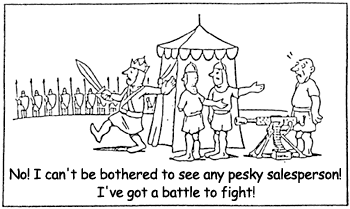 All of us know that in most cases not all of the specifications are decided upon early on. Yet, the more precise you are up front, the better your chances are that the bids are indeed 'apples to apples'. This is especially important when you still have creative to be approved, budgets to be OK'd, and PO's have to be cut etc.